Showing posts with label Homegrown. Show all posts

Tuesday, January 21, 2014

From grass to bulging veggie garden in under six months

  I’ve been reading tutorial posts elsewhere about starting veggie gardens, and no wonder people give up on the idea before they start. Why do people have to complicate things which are actually quite simple? Or turn it into a mammoth shopping list that makes buying vegies for the rest of your life seem like the cheap deal?

  We are experts at starting veggie gardens. Before you pass me off as an up-myself snob, remember that the husband and I have lived in well over 20 houses in our 13-odd years together. Starting them, we excel at. Learning to keep them going well for years………..well, maybe one day we’ll get the chance. Our way involves using your muscles for the initial start-up, but not your wallet. Most people could do with using their muscles more, so don’t be shy-get out there, toughen up, and do some work you can be proud of and reap the benefits from for years.

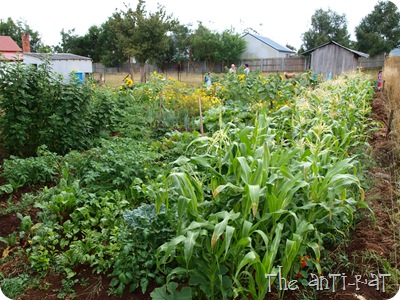
PC246470    200sq/m, less than six months

Here’s our well-honed method.

  Pick a sunny spot. Here in Australia, with our intense sun, you can get away with some shade. But try to minimise it. If you have lots of shade everywhere, go ahead and do it anyway, but resign yourself to leafy veg. Under trees is also not so good-they’ll steal from your vegies. Start with a manageable size-you can always expand later once your original area is set-up, but beginning with a huge area can be discouraging.

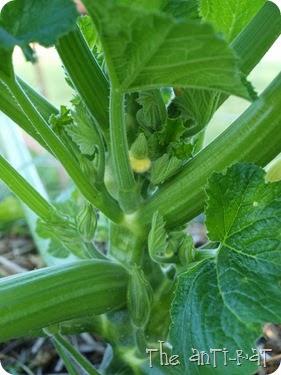
  Peel off the grass. All of the grass. A mattock is the best for this. You may think you want lovely grassy paths, with rocks/sleepers for edging, but you don’t. Well, you won’t once the reality of them sinks in. Grassy paths suck the nutrients and water from your garden, and the grass invades through your pretty edging. Without herbicide, you’ll have a grassy garden fairly quickly. As you’re not a ruminant, and cannot digest the grass, that is bad. Make a compost pile with the sod.
PA226067

  Dig over the dirt. It doesn’t need to be deeply dug, just rough it up a little. A fork is good for this-sink in the tines, wiggle it around and lever it part of the way up. Repeat. Throw on as much manure as you can get-fresh, old, from any farm animal will do. Manure is plentiful, and there’s always people around wanting to get rid of it-find people who keep animals and don’t garden, try stables, ask any farmers you know. Ask on local online groups if anyone wants you to come around and clean up their mess. You’ll meet some interesting people. We’ve spent a lot of time wandering in paddocks picking up muck-but we most definitely don’t go to Bunnings and buy bagged manure. Actually, we don’t go to Bunnings ever, but that’s another story.  Spread the lovely muck over your dirt, and inhale the beautiful stink-that stink is the smell of fertility, and future food for you.

Cover the lot with mulch. Sugar cane, lucerne, pea straw, whatever’s available in your area. Again, if you look you can usually pick up bales of straw fairly cheaply from the side of the road. Or, you can rake up the council mowings from the side of the road in the country. Water it well, then rest your aching muscles for a week or so.

  Now, it’s time to plan. Decide where you want your beds to be, and tramp paths around them. Stomp down hard and you should soon be able to see them clearly. Your paths will be manured and mulched just as heavily as your beds-and why not? Your plants can spread their roots out there, so lets make it tasty for them. (Admittedly, we currently have bare paths, but we have an unfair amount of local red-bellied black snakes). Make sure your paths and beds are a decent width, but that you can reach the centre of the beds. Water it again.

PB246297

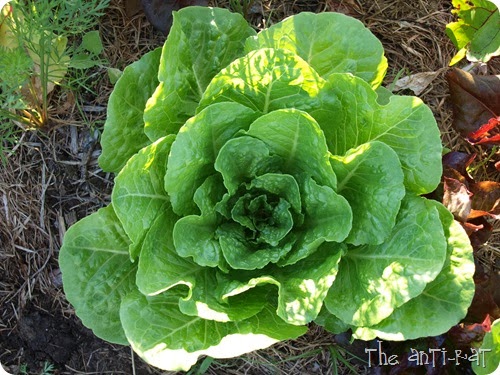
  Plant seeds, according to season. Scrape the mulch back, make sure the soil is damp, break up any clods if needed, and plant away. Seedlings are too much bother-home-started seedlings have their place, but for now it’s an unnecessary complication. Keep it simple. Plant your plants at random, forget about neat beds of one type of plant. Lettuces grow well in the shade of other plants, radishes grow so fast you pull them before the tomatoes next to them are big enough to be bothered, and so on. In the beginning your germination will be poor, so plant thickly. You can always thin, and eat the thinnings. But you want success, so go crazy. Seeds are cheap. My favourite supplier is Rangeview Seeds.
PA226069

  Keep in watered, and watch it grow. Attention is the key-go for a walk around it every day. Get down low, and really look. Learn what your plants, and your weeds, look like when they come up. Keep an eye on the bugs and work out which ones are helpful, and which you should feed to the chooks. Learn what grows well together, and what doesn’t. Work out what grows really well in your area and gather lots of recipes containing it. Conversely, learn what you shouldn’t bother with, as it gets struck down with pests/disease, or hates the weather. This step is not optional if you want garden success-it doesn’t take much time, but attention is the difference between success and failure.

 PC286496 A visitor in the corn patch

  There you go. You’re a gardener. That wasn’t so hard, was it?

Wednesday, April 24, 2013

7 months and 10 days in Tasmania.

  Not that I was counting or anything. Oh, but how glad I am it is all over-and so quickly! We expected to be there for much longer, living in limbo, waiting for the freedom that selling our house would give us. And it was all over and done with before winter began. 

  We decided to make the most of it, and while renovating our house started visiting the local attractions-North-East Park

P8092110

  Ralph Falls and Cash’s Gorge

P8112188

P8112187

The majestic White Knights, at Mathinna. Somewhat ruined by the astonishing amount of leeches there, and us not having salt in our kit.

 P2253979

P2253988

I forgot the camera for Columba Falls. Oh, and Lilydale Falls. The site of the infamous snake episode, years ago. None spotted this time thankfully!

And basically tried to settle in as much as possible-and when you’re us, and you have half an acre of beautiful soil at your disposal, that means producing food. Hello meat, for the first time in four years! We bought five sheep, and ate three. As my sister-in-law told us, we lost our vege-tinity.

P9122365

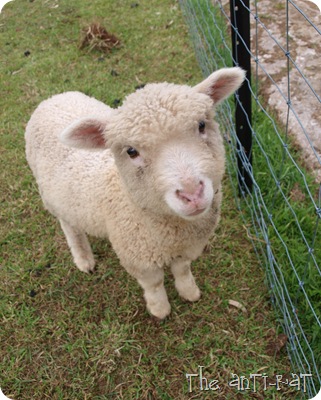
Doesn’t he look tasty? But Sam the Lamb escaped the slaughterman (for now), and was sold with the house.

P9162388

  13 Rhode Island Reds kept us piled with eggs.

P9122345

And hatched seven babies!  A chicken book the husband was reading recently stated that RIR’s do not go broody. Obviously a book Mrs Broody hadn’t read.

PB133016

PB223132

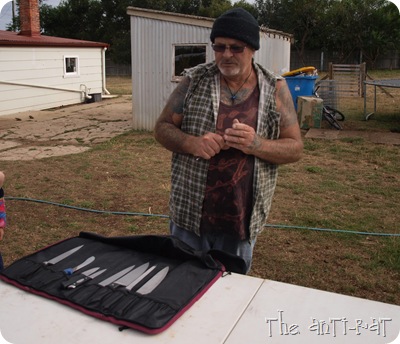
   Um, we ate three of those babies too. Our friend was willing to teach us how, so we had a tatt-covered bloke turn up with lots of very sharp knives. We had lots of giggles about being friends with him-i’m sure most people assumed that with the overload of tattoos and dreadlocks between the three of us, we were up to something more illegal and interesting than sitting around drinking herbal tea and talking animal husbandry.

P2133817

  I’ll keep the photos of the next part of the process to myself though, as i’m sure the vegans wouldn’t appreciate them. Come to think of it, most meat eaters wouldn’t either. IF slaughterhouses had glass walls etc…….

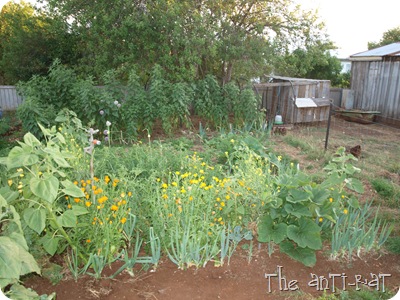
  We gardened. This is what a couple of months, a pick and a shovel can do to a patch of grass.

P2264024

P2133870

P2264014

  Considering the hail storm we had in late October (see below), we ended the summer pretty well. While people rave about gardening in Tasmania, i’m not a fan. Give me more pests and a longer growing season any day. We literally got about six weeks of okay summer growing weather, and by the start of March when we left we’d had two ripe tomatoes. Considering we’ve lived in places where we’ve had tomatoes all year around…………..they can keep their brassicas!

PA212836

  I finally started my herbal medicine study, but that’s on pause, maybe never to be resumed, as I was horribly disappointed with the quality of the course. I’m still waiting for a resolution of my complaints about references and accuracy-it’s time to go to the next stage of making sure they can’t ignore me, I think. But we grew many herbs, I made infused oils from comfrey and calendula that work amazingly, plus many other practical experiments. I feel like a mad scientist, which is probably why I like it so much.

  And that was about it. After living in a few places in a row knowing they were going to be temporary, I just couldn’t muster up the energy required to get out and do permanent-type things there. So I spent most of my time at home, got a hell of a lot of sewing and tie-dyeing done, got obsessed with the classical method of home education and began weaving that into our life, and basically kept myself manically busy while I crossed my fingers that this last hurdle of ours towards a permanent, stable life would be over quickly. And it was! When the house settled we had grand plans of travelling all around Tasmania. In the end we spent four days at Lagoons Beach (spectacular, free, highly recommended)

P3024080

P3024044

Then we decided we’d had enough, booked tickets, spent six days enjoying the north-west, and got on the Spirit of Tasmania. A night in the ocean recliners was enough to convince us that we never want to live on an island again (the mainland doesn’t count), we all cheered when our tyres hit the ground in the morning, and we were ready to head north again.

So, we were happy there. But now it’s done, and i’m nothing except glad. Phew.

Tuesday, March 29, 2011

Going car-free, part 2

  So now we’ve gotten rid of the car, how on earth do we buy big bags of flour, animal feed etc?

  Food shopping-we don’t get much from the supermarket, so we don’t have to lug $300 worth of stuff home in one go. We can generally stack a weekly shop on the top two seats of the monster pram. The husband goes to the markets weekly for fruit/veg/honey etc, and he takes my bike, loads up the hobo milk crate, sticks a bag on each handlebar and teeters precariously home. He still says that it’s much easier than trying to find a park, then lugging all the purchases to the car. He can take the bike right to the stalls.

  Bulk foods-for us, this is only available in the next town, about 40kms away. Dragging huge bags of stuff home on the bus is not do-able. I have two options.

DSCF5951 

1-Impose on a friend, but in a very small way. I can ring up the store, order everything I want, and pay for it with my debit card. They will pack it all up in bags and boxes, then the next time a friend goes they pick it up for us. I hate asking for anything from anyone in general, but this is fine as the storefolk will even take it out to the car for them.

2-Organise a co-op, or bulk-buy. This is something i’m working on, simply because I can then get organic flours and grains (which are prohibitively difficult and expensive to get here right now) way under the retail price. And when you chomp through as much food as we seven gluttons do, it makes a big difference. I’ll let you know how it goes.

  Animal feed-15 chickens, a cat and two guinea pigs need more than scraps can provide.

1-Grow more. We have kale and lettuces mostly for the chooks. They’re also partial to fallen guavas, and as these are right next to the neighbours bedroom window, we pick these up and take them to the chooks rather than vice-versa. We’ve also been experimenting with blocking off part of their run and growing grains to about 20cm, then opening it back up for them to forage-it’s working very well. No transport necessary for this one. Except the grain home, but it grows exponentially.

DSCF7041 One of our New Hampshires indulging in wheatgrass. The kids scoffed it too.

2-Ask for delivery. I can get the organic, vegetarian chook feed we’ve been using delivered, but it’s $40 a bag. Eek. That’s just the local price though-I was getting mine for $32 from another town. So a better fix is…….

3-To ring up the company listed on the bag and discover they do co-op sales. So if I can sell between 20-50 bags, I can have it at $22 + freight a bag. Much better. I’m aiming for 50 to reduce freight-we’ll take at least 7 so shouldn’t be too hard. So if you know me, and you want to put in your order for organic chook feed, please do!

4-We also still swing by the dumpsters as often as we can. Two-day old bread is guaranteed (there’s normally at least five garbage bags full of it in one supermarket’s bin) and there’s usually yoghurt, milk or custard to mix it with, plus some fruit. Including bananas last week. Yes, they’re throwing out bananas at $10 a kilo-literally!

  The last problem was bales of mulch. But then the farmer said, yes, he delivers for $10. That is cheaper than it would be for us to pick them up from about 10kms away, all things considered. We don’t have to hook up the trailer, drive out there, load them up, do a tricky reverse through the mud, drive home and unload. They just arrive, like magic.

  And that brings me to possibly the biggest bonus of not owning a car-the time saved. Which doesn’t make much sense, don’t cars save you time? So many things that I would normally unthinkingly jump in the car to go and do i’ve stopped to think about instead, and come up with a better option. I’ve been ringing around rather than driving places to have a look, asking about delivery options, and tracking down companies to see if I can buy direct. It’s saving so much wasted time. And it seems to be saving me money, not costing me money.

  Which is the basis of my next post-how much money we’re saving.

Friday, March 11, 2011

Making a bathtub garden

  Moving into a rental means gardening downsizes. There’s no point spending time and money on improving someone else’s soil, when the odds are we’ll move within a year. But small pots are so troublesome to look after, so I came up with this idea-now even our garden beds are transportable! We’ll just load them up onto the hire truck and take our soil and crops with us, and have no break in garden productivity. This one is based loosely on the wicking worm beds design, so it will suit us perfectly over winter here in Queensland. If you’re in a different climate you may want to do your drainage differently to suit. I know now I definitely need to cover them over summer-they dealt very badly with 100mL+ of rain in a day. Repeatedly.

  Here’s how to do it. (note: i’d been stockpiling fill for this one in it, hence the dirtiness-I had to dig it all out to do it)

  1. Find yourself a bathtub. Tip shops are a great place to start-ours charges $10 for a basic one, $15 with fittings.

  2. Give it a good scrub out, taking special care to clean and dry the plughole. Now, silicon a 20cm length of pipe (pvc, poly etc) into the plug, making sure it’s watertight. Slather it on. Leave to dry completely.

  3. Rubber band some flywire or nylon netting (something that won’t rot) over the opening of your pipe. This is your drainage outlet, and it is higher than the base to give you a water reservoir.

DSCF6894
  4. Make your two watering pipes. These are anchored in the beds, allowing you to water straight to the bottom of the bath, minimising evaporation. The length of pipe you will need depends on your bath-one end needs to sit on the bottom while the other will protrude from the soil. Drill holes all around the base of your pipes, to about 20cm up.

DSCF6895
  5. Fill your base with drainage material. Some people advocate rocks or sand, but they’re tiresome to clean out (which will need doing every few years). Sticks, unfit macadamias and poinciana pods from the backyard are a better option IMO-wood is a great water retainer, and they break down so sloooowly that nitrogen draw-down shouldn’t be a problem. Just keep it chunky.

DSCF6896
  6. Anchor your watering pipes in their places, using some of your soil. I went to step 7 before remembering to take the photo, sorry.

DSCF6897
  7. Throw a layer of mulch in-I used sugar cane, use whatever is available to you locally, that is weed-free. This gives it bulk and aeration. STOP worrying about nitrogen draw-down, i’ve got it under control here.

DSCF6898
8. Now, add anything you’ve got in your garden that will give it nutrients. I’ve got  comfrey leaves and a couple of borage plants that keeled over and died in the floods. Plus a few banana peels that the kids threw in on their way past-it’s all organic material, right?

DSCF6899
  9. Fill it up with growing medium! I think there’s some potting mix, cow manure and mushroom compost here, with a little dug-up garden soil to fill it up. Plus more of the icky macadamias, to save our bare feet. The food you get out of it will be equivalent to the quality of what you put in, so don’t be tempted to fill it up with crap-or you will eat crap.

DSCF6900
  10. Mulch well, water thoroughly and let sit for a couple of weeks. Then plant, wait and dine!

DSCF6901
  You could also build boxes for them out of timber from old pallets if they’re permanent, and paint them up nicely. You could use them around the edge of a patio, or instead of a rail along an edge in the garden. Grow herbs in them next to the BBQ, or right next to the back door…………


MAINTENANCE
They’re pretty easy to look after, but here’s a few pointers.

-Like any plant in a container, they’ll need regular feeding. I throw on a few handfuls of mulch from the chook run when it’s getting sparse-this will not burn them in small amounts. Any mulch that will also feed it is great. We also have a slow-release organic fertiliser-make sure anything you buy is CERTIFIED organic. Organic is slapped on many, many garden products that aren’t ‘organic’ in the non-chemical means.

-Don’t let them get too wet. They do not drain quickly. That is the idea, so there’s plenty of moisture in dry times.

-Seedlings and seeds will need water from above until their roots hit the wet zone.

-They will probably need to be dug out and re-done periodically. I’ve had some going for 9 months and they’re fine, so I have no idea how often. It sounds like a crappy task so look after the soil in them and you should be able to drag it out to once every couple of years.

Just use good sense, follow basic container planting guidelines, and you should be fine.

Friday, November 26, 2010

Mystery pumpkin

Another result of my whacking in seeds thinking i’ll remember, but I never do. I discovered this stalwart at the property in an abandoned garden bed, along with two massive bright yellow marrows. I *think* it’s a Blue Banana Jumbo which looks like it’s now sold out (I couldn’t resist buying something called that………..and yes I bought the Pink too).

DSCF6552 

DSCF6554

It took the husband about five minutes and risking chopping his arm off to get it in half-it would be a great keeper. It was crap roasted, dry and floury, but made pretty good soup if I do say so myself.